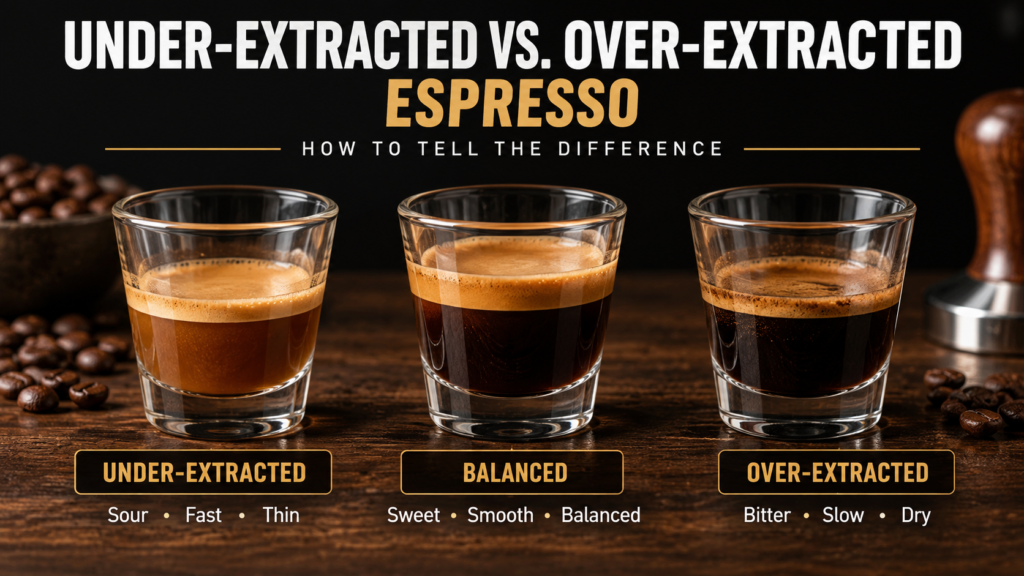
One of the fastest ways to improve your espresso is learning to recognize under-extraction and over-extraction.
When espresso is under-extracted, water hasn’t dissolved enough flavor from the coffee. The result is often sour, sharp, thin, or weak.
When espresso is over-extracted, water has pulled too much from the coffee. The result can taste bitter, dry, harsh, or hollow.
The good news is that once you understand the signs, both problems are usually straightforward to fix.
Affiliate Disclosure: Espresso Decoded is reader-supported. As an Amazon Associate, we earn from qualifying purchases. If you buy through links on this page, we may earn a commission at no additional cost to you.
Under-Extracted vs. Over-Extracted Espresso at a Glance
| Under-Extracted Espresso | Over-Extracted Espresso | |
|---|---|---|
| Typical taste | Sour, sharp, thin | Bitter, dry, harsh |
| Shot flow | Often too fast | Often too slow |
| Common grind issue | Too coarse | Too fine |
| Extraction | Too little | Too much |
| First adjustment | Grind finer | Grind coarser |
These are useful guidelines, but taste should always be your final judge.
A fast espresso shot isn’t automatically under-extracted, and a slow shot isn’t automatically over-extracted. Shot time, grind size, dose, yield, and coffee type all work together.
What Does Espresso Extraction Mean?
Extraction is simply the process of dissolving flavor compounds from ground coffee using water.
When hot water passes through the coffee puck, it extracts acids, sugars, oils, bitter compounds, and many other substances.
The goal isn’t to extract everything.
Instead, you want enough extraction to create a balanced cup with pleasant acidity, sweetness, body, and bitterness.
If you extract too little, the espresso tends to taste sour and undeveloped.
If you extract too much, bitterness and dryness can dominate.
What Is Under-Extracted Espresso?
Under-extracted espresso occurs when water doesn’t remove enough soluble material from the coffee.
The shot finishes before enough desirable flavor has been extracted.
What Does Under-Extracted Espresso Taste Like?
Common signs include:
- Sourness
- Sharp acidity
- Thin body
- Weak sweetness
- Salty or vegetal flavors
- A short, unpleasant finish
People sometimes confuse sourness with normal coffee acidity.
Good acidity can taste bright, fruity, or lively.
Under-extraction tends to taste more aggressive, sharp, or unpleasant.
If this sounds familiar, see our guide to why espresso tastes sour.
What Causes Under-Extraction?
Several variables can cause espresso to extract too little.
Grind Size Is Too Coarse
This is one of the most common causes.
When coffee is ground too coarsely, water can move through the puck too easily.
That reduces contact time and can produce a fast, sour shot.
The usual fix:
Grind finer.
A finer grind increases resistance and slows the flow of water.
For a deeper explanation, see our espresso grind size guide.
The Shot Runs Too Fast
If your espresso reaches its target yield very quickly, there may not be enough time for proper extraction.
A common starting range for espresso is around 25 to 30 seconds, although excellent shots can fall outside that range.
If your shot finishes in 15 or 18 seconds and tastes sour, grind finer.
See our guide to espresso shot time for more detail.
Your Brew Ratio May Be Too Short
Imagine using:
18 grams of coffee
→ 25 grams of espresso
That produces a relatively short shot.
Depending on the beans and recipe, you may not be extracting enough.
Increasing your yield slightly—for example, from 25 grams to 36 grams—can increase extraction.
See our espresso brew ratio guide to understand how dose and yield work together.
Water Temperature Is Too Low
Water that is too cool extracts coffee less efficiently.
This is particularly relevant with lighter roasts, which can be more difficult to extract than darker coffees.
If your machine allows temperature adjustment, a small increase can sometimes help.
What Is Over-Extracted Espresso?
Over-extracted espresso happens when too much material is pulled from the coffee.
The shot continues extracting beyond the point where the best flavors have already been dissolved.
What Does Over-Extracted Espresso Taste Like?
Common signs include:
- Strong bitterness
- Dry or astringent mouthfeel
- Harshness
- Burnt or woody flavors
- Hollow finish
- Unpleasant lingering aftertaste
Bitterness itself isn’t automatically bad.
Espresso naturally contains bitterness.
The problem is when bitterness overwhelms sweetness and acidity.
If that’s happening, see our guide to why espresso tastes bitter.
What Causes Over-Extraction?
Grind Size Is Too Fine
Coffee that is ground extremely fine creates more resistance.
Water moves through the puck slowly and spends more time extracting compounds.
The first adjustment is usually:
Grind coarser.
Make small changes rather than large ones.
A minor adjustment can significantly change shot time.
The Shot Runs Too Long
If your target yield takes 45 or 50 seconds to reach, the shot may extract more than intended.
That doesn’t automatically mean it will taste bad, but if it also tastes bitter or dry, grind coarser.
Your Yield Is Too High
Increasing the amount of water passing through the puck generally increases extraction.
For example:
18 grams in
→ 60 grams out
will usually extract more from the coffee than:
18 grams in
→ 36 grams out
If your espresso tastes dry and bitter, reducing your yield can sometimes help.
Water Temperature Is Too High
Hotter water extracts coffee more efficiently.
If the temperature is excessively high—especially with darker roasts—you may increase unpleasant bitterness.
If your espresso machine allows temperature control, try reducing it slightly.
How to Tell Whether Your Espresso Is Under- or Over-Extracted
Don’t diagnose espresso based on one number.
Instead, look at three things:
1. Taste
Taste is the most important signal.
Sour, sharp, thin: likely under-extracted.
Bitter, dry, harsh: likely over-extracted.
2. Shot Time
Shot time provides context.
If an 18g dose produces 36g of espresso in 16 seconds and tastes sour, under-extraction is a strong possibility.
If the same recipe takes 48 seconds and tastes dry and bitter, over-extraction is more likely.
3. Flow
Watch the espresso as it leaves the portafilter.
If it pours extremely quickly and becomes pale almost immediately, the shot may be running too fast.
If it barely drips for a long period, your grind may be too fine.
The Best Way to Fix Under-Extracted Espresso
Change one variable at a time.
Start with grind size.
If the espresso tastes sour:
- Grind slightly finer.
- Keep the same dose.
- Keep the same target yield.
- Pull another shot.
- Taste again.
If the shot improves, you’re moving in the right direction.
You can then fine-tune yield or temperature if needed.
The Best Way to Fix Over-Extracted Espresso
Again, start with grind size.
If the espresso tastes excessively bitter or dry:
- Grind slightly coarser.
- Keep the dose consistent.
- Keep the same yield.
- Pull another shot.
- Taste.
The goal is to isolate variables so you understand what’s actually changing the flavor.
A Simple Espresso Dial-In Example
Let’s say you’re using:
18g coffee → 36g espresso
Your first shot takes:
18 seconds
and tastes sour.
Try grinding finer.
Your second shot takes:
25 seconds
and tastes sweeter and more balanced.
You’re getting closer.
You make one more small grind adjustment.
Your third shot takes:
29 seconds
and tastes excellent.
Stop.
You don’t need to keep changing the recipe just because another guide says 30 seconds is ideal.
The espresso in the cup matters more than the stopwatch.
Can Espresso Be Both Sour and Bitter?
Yes.
This often happens because of uneven extraction.
Parts of the coffee puck may be under-extracted while other areas are over-extracted.
One common cause is channeling, where water finds weak paths through the coffee rather than flowing evenly through the entire puck.
That can produce a confusing combination of sourness, bitterness, and thin body.
Good puck preparation can help:
- Distribute coffee evenly
- Break up clumps
- Tamp level
- Avoid disturbing the puck before brewing
This is why taste alone sometimes doesn’t fit neatly into “under” or “over” extraction.
Does Crema Tell You If Espresso Is Properly Extracted?
Not reliably.
Crema can provide some clues about freshness, roast level, and the coffee itself, but a thick layer of crema doesn’t guarantee a good extraction.
You can have beautiful crema on a bad-tasting shot.
Likewise, some excellent espresso may have relatively little crema.
For more detail, read What Is Espresso Crema?
A Coffee Scale Makes Dialing In Easier
If you’re trying to diagnose under- or over-extraction, a coffee scale with a built-in timer is one of the most useful tools you can own.
It lets you track:
- Coffee dose
- Espresso yield
- Shot time
Instead of guessing, you can repeat the same recipe and make controlled adjustments.
Frequently Asked Questions
Is Sour Espresso Under-Extracted?
Usually, yes.
Strong, unpleasant sourness is one of the most common signs of under-extraction. Try grinding finer or increasing extraction slightly.
Is Bitter Espresso Over-Extracted?
Often, but not always.
Bitterness can also come from dark-roasted beans, very high brewing temperatures, or the coffee itself.
Does a Longer Shot Mean More Extraction?
Generally, more contact between water and coffee can increase extraction, but shot time alone doesn’t determine extraction.
Grind size, yield, temperature, and puck preparation also matter.
Should I Change Grind Size or Dose First?
For most home baristas, change grind size first.
Keeping dose and yield constant makes it much easier to understand how each adjustment affects the espresso.
What Is a Good Starting Espresso Recipe?
A very common starting point is:
18g coffee → 36g espresso → roughly 25–30 seconds
Treat that as a baseline, not a rule.
Taste the espresso and adjust from there.
Final Thoughts
The easiest way to think about espresso extraction is:
Sour and thin → probably under-extracted.
Bitter and dry → probably over-extracted.
If you’re under-extracting, try grinding finer.
If you’re over-extracting, try grinding coarser.
Then keep your dose and yield consistent while you make small adjustments.
Over time, you’ll stop relying on rigid rules and start using taste, shot time, grind size, and brew ratio together to dial in espresso more confidently.