Disclosure: This post contains affiliate links. If you purchase through one of these links, we may earn a commission at no additional cost to you
If you’re learning how to make espresso, you’ve probably come across ratios like 1:1, 1:2, or 1:3.
But what do those numbers actually mean?
An espresso ratio describes the relationship between the amount of ground coffee you put into your portafilter and the amount of liquid espresso you produce.
Understanding this ratio makes it much easier to dial in espresso consistently—and to figure out what to change when your shot tastes sour, bitter, weak, or overly strong.
In this guide, we’ll explain how espresso ratios work, why the 1:2 ratio is a great starting point, and how changing your ratio affects the taste of your espresso.
What Is an Espresso Ratio?
An espresso ratio, also called a brew ratio, compares your dose of ground coffee with the final weight of espresso in your cup.
For example, if you use:
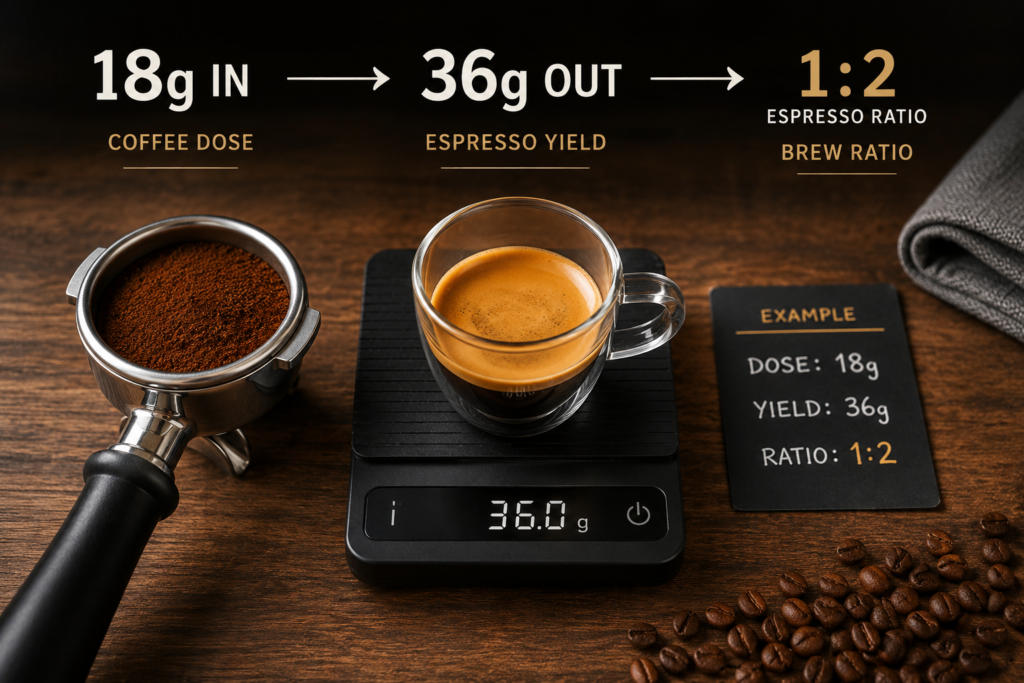
18 grams of coffee → 36 grams of espresso
your espresso ratio is 1:2.
For every gram of ground coffee, you produce two grams of espresso.
Another example:
18 grams of coffee → 27 grams of espresso
That gives you a 1:1.5 ratio.
And:
18 grams of coffee → 54 grams of espresso
would be a 1:3 ratio.
The easiest way to measure espresso ratios accurately is with a digital scale rather than relying on the volume of espresso in the cup.
Helpful tool: A compact espresso scale with a built-in timer makes it easy to measure both your espresso yield and shot time while dialing in your recipe.
What Is the Best Espresso Ratio?
For most home baristas, a 1:2 espresso ratio is the best place to start.
That means producing approximately twice as much espresso as the amount of ground coffee you use.
A typical recipe might look like this:
Dose: 18 grams
Yield: 36 grams
Espresso ratio: 1:2
Shot time: approximately 25–30 seconds
This isn’t a rule that every espresso must follow. Think of it as a reliable baseline.
Once you have a consistent 1:2 shot, you can adjust the ratio based on how the espresso tastes.
Common Espresso Ratios
Espresso ratios generally fall into three broad categories.
1:1 to 1:1.5 — Ristretto
A ristretto uses less water relative to the amount of coffee.
For an 18-gram dose, you might produce approximately:
18–27 grams of espresso
Because the shot is stopped at a lower yield, a ristretto is typically smaller and more concentrated.
It can have a heavier body and more intense flavor than a traditional espresso.
1:2 — Traditional Espresso
A 1:2 ratio is one of the most common starting points for modern espresso.
Using 18 grams of coffee, you would aim for approximately:
36 grams of espresso
This ratio often provides a good balance between strength, body, sweetness, and extraction, which is why it works so well as a baseline when dialing in new coffee beans.
1:3 — Lungo
A longer ratio uses more water through the same amount of ground coffee.
For example:
18 grams of coffee → 54 grams of espresso
This would be approximately a 1:3 ratio.
The resulting shot is larger and less concentrated, but the additional water passing through the coffee also extracts more soluble compounds.
That means a lungo isn’t simply a regular espresso diluted with water.
How to Calculate Espresso Ratio
The formula is simple:
Espresso yield ÷ coffee dose = brew ratio
Suppose you use 18 grams of coffee and produce 36 grams of espresso:
36 ÷ 18 = 2
Your ratio is therefore 1:2.
If you produce 45 grams instead:
45 ÷ 18 = 2.5
That’s a 1:2.5 espresso ratio.
You don’t need to hit perfectly round numbers. A shot that uses 18 grams of coffee and produces 38 grams of espresso is perfectly reasonable if it tastes good.
The ratio is a tool for making your espresso repeatable—not a rule you have to follow exactly.
How Espresso Ratio Affects Taste
Changing your espresso ratio changes both the strength and extraction of your shot.
If you keep your dose the same but stop the shot earlier, you’ll produce a smaller, more concentrated espresso.
If you allow more water to pass through the coffee, you’ll produce a larger, less concentrated shot while generally extracting more from the coffee.
This can be useful when dialing in by taste.
If your espresso tastes sour or under-extracted, increasing the yield slightly may help extract more from the coffee.
If your espresso tastes dry, harsh, or excessively bitter, reducing the yield may sometimes help.
However, ratio is only one variable. Grind size, dose, temperature, shot time, coffee beans, and puck preparation all influence extraction.
If your espresso consistently tastes sour, read our guide to why espresso tastes sour.
If your shots are harsh or unpleasantly bitter, see why espresso tastes bitter.
Espresso Ratio vs. Shot Time
Espresso ratio and shot time measure two different things.
Espresso ratio tells you how much espresso you produced relative to your coffee dose.
Shot time tells you how long it took to produce it.
For example, your recipe might be:
18 grams in → 36 grams out → 28 seconds
The 18-to-36 relationship gives you your 1:2 ratio, while 28 seconds is your shot time.
When pulling espresso, it’s generally better to stop the shot when you reach your desired yield rather than stopping simply because the timer reaches a certain number.
Then use shot time as a diagnostic tool.
If you reach 36 grams in only 15 seconds, your shot is probably flowing too quickly.
If reaching 36 grams takes 50 seconds, the shot is probably flowing too slowly.
For more detail, see our guide to espresso shot time and how long a shot should take.
Espresso Ratio vs. Grind Size
Your espresso ratio tells you the recipe you’re trying to make.
Your grind size helps determine how quickly you get there.
Suppose you’re targeting:
18 grams in → 36 grams out
If your machine reaches 36 grams far too quickly, grinding finer will generally slow the flow.
If it takes far too long, grinding coarser will generally speed it up.
This is why changing grind size is one of the most useful adjustments when dialing in espresso.
Our espresso grind size guide explains how to make these adjustments in more detail.
Should You Use Volume or Weight?
Use weight whenever possible.
You may see traditional espresso recipes described in ounces or milliliters, but volume can be misleading because espresso contains crema.
Two shots containing the same amount of liquid coffee can appear to have different volumes simply because one has more crema.
A scale gives you a much more consistent measurement.
Instead of trying to visually determine whether you’ve produced two ounces of espresso, place your cup on a scale and measure your yield in grams.
Does Roast Level Affect Espresso Ratio?
It can.
Different coffees often taste best with different recipes.
Darker roasts are generally easier to extract and may taste good with somewhat shorter ratios.
Lighter roasts can be more difficult to extract and sometimes benefit from longer ratios, such as 1:2.5 or 1:3.
That doesn’t mean every dark roast should be brewed as a ristretto or every light roast should use a 1:3 ratio.
Start with a basic recipe—such as 18 grams in and 36 grams out—and adjust according to taste.
A Simple Espresso Recipe for Beginners
If you’re not sure where to start, try:
Dose: 18 grams
Yield: 36 grams
Ratio: 1:2
Time: approximately 25–30 seconds
Then taste the espresso.
If it tastes sour, you may need more extraction. Try grinding finer or slightly increasing your yield.
If it tastes harsh, dry, or bitter, you may need less extraction. Try grinding coarser or slightly reducing your yield.
Change one variable at a time so you know which adjustment actually improved the shot.
Espresso Ratio FAQ
Is 1:2 the best espresso ratio?
A 1:2 ratio is an excellent starting point, but there is no single best espresso ratio for every coffee. Some beans taste better with shorter ratios while others benefit from longer extractions.
What does a 1:2 espresso ratio mean?
A 1:2 espresso ratio means producing two grams of espresso for every gram of ground coffee. For example, 18 grams of coffee producing 36 grams of espresso is a 1:2 ratio.
What espresso ratio should I use for 18 grams of coffee?
At a 1:2 ratio, an 18-gram dose would produce approximately 36 grams of espresso. At 1:2.5, you would target 45 grams, and at 1:3, you would target 54 grams.
Is a 1:3 ratio still espresso?
Yes. A 1:3 brew ratio is commonly associated with a longer espresso or lungo-style extraction. The exact definitions of espresso styles can vary, but a longer ratio can still be used to make espresso.
Should I change espresso ratio or grind size first?
If you’re starting with a reasonable recipe such as 1:2, use grind size to get your shot flowing within a sensible time range. Once you’re close, adjust the ratio according to taste. Avoid changing several variables simultaneously.
Final Thoughts
The espresso ratio is one of the simplest tools you can use to make better, more consistent espresso.
A 1:2 ratio—such as 18 grams of coffee producing 36 grams of espresso—is an excellent starting point for most home baristas.
From there, don’t be afraid to experiment.
Shorter ratios can produce smaller, more concentrated shots, while longer ratios can increase extraction and produce a larger, less concentrated espresso.
Most importantly, use the numbers as a guide rather than a rigid rule.
Measure your dose. Measure your yield. Watch your shot time. Then let taste tell you what to change.