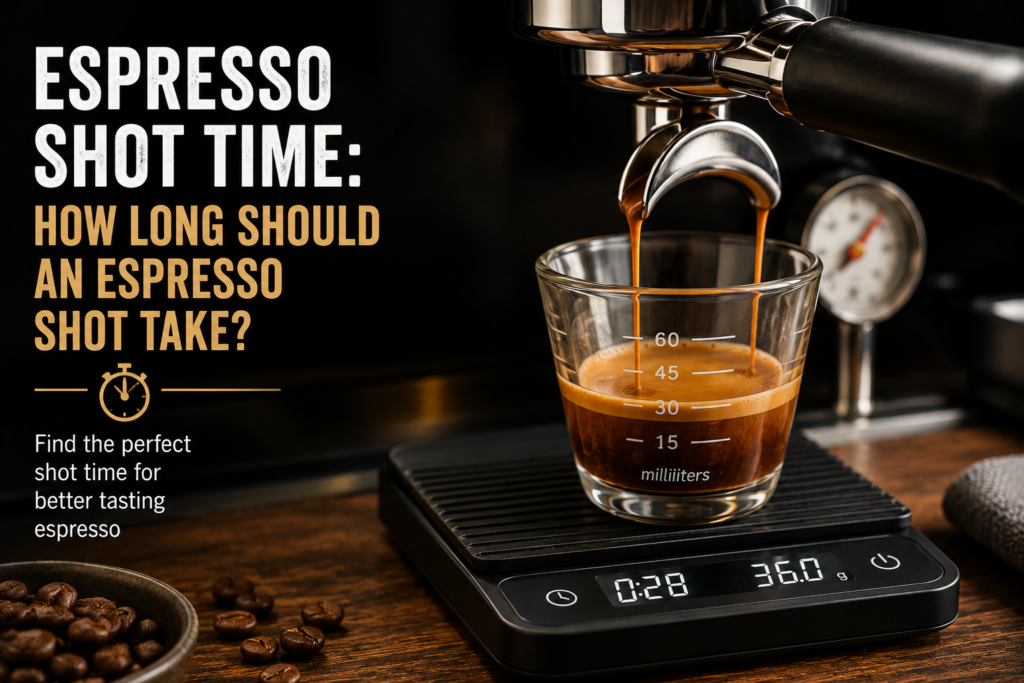
Espresso shot time is typically around 25 to 30 seconds, measured from the moment you start the pump. But that doesn’t mean every great espresso shot needs to fall within that exact window.
Shot time is best used as a diagnostic tool alongside brew ratio and taste. A delicious espresso might take 22 seconds or 35 seconds depending on the coffee, grind size, dose, and recipe.
In this guide, we’ll explain how long an espresso shot should take, when you should start the timer, and what to change when your espresso runs too fast or too slow.
Affiliate Disclosure: Espresso Decoded is reader-supported. As an Amazon Associate, we earn from qualifying purchases. If you buy through links on this page, we may earn a commission at no additional cost to you.
Espresso Shot Time Quick Reference
If you’re dialing in espresso, use these ranges as a starting point:
| Shot Time | What It May Indicate | First Adjustment |
|---|---|---|
| Under 20 seconds | Much too fast | Grind finer |
| 20–25 seconds | Slightly fast | Taste first; grind finer if sour |
| 25–30 seconds | Common starting range | Taste before adjusting |
| 30–35 seconds | Slightly slow | Taste first; grind coarser if bitter or dry |
| 35+ seconds | Very slow | Grind coarser |
These ranges are guidelines, not rules. If your espresso tastes balanced and enjoyable, don’t change your recipe simply because the timer falls outside the traditional 25-to-30-second window.
What Is Espresso Shot Time?
Espresso shot time is the amount of time it takes your espresso machine to produce your desired yield after you begin the extraction.
A common starting recipe might look like this:
Dose: 18 grams
Yield: 36 grams
Shot time: 28 seconds
That’s a 1:2 brew ratio: 18 grams of ground coffee producing 36 grams of liquid espresso.
Shot time gives you useful information about how quickly water is moving through the coffee puck. When dialing in espresso, changes in shot time can help you identify whether you should adjust your grind or another variable.
What Is the Ideal Espresso Shot Time?
For many espresso recipes, 25 to 30 seconds is a useful starting point.
However, there isn’t one universally correct espresso shot time.
Different beans, roast levels, grinders, machines, doses, and brew ratios can all change the ideal extraction time.
A shot that takes 24 seconds might taste fantastic, while another coffee may taste better at 32 seconds.
Instead of trying to hit exactly 30 seconds every time, use shot time to get into a reasonable range and then let taste determine your final adjustments.
When Should You Start Timing an Espresso Shot?
Start timing your espresso shot when you activate the pump, not when the first drops of espresso appear in the cup.
Starting at pump activation gives you a consistent reference point from shot to shot and includes the time water spends saturating the coffee puck before espresso begins flowing.
Some espresso machines use pre-infusion, during which the coffee puck is exposed to water at lower pressure before full extraction begins. That can make direct shot-time comparisons between different machines less useful.
The most important thing is consistency. Pick one timing method and use it every time you dial in your espresso.
Why Does Espresso Shot Time Matter?
Shot time provides clues about what’s happening during extraction.
When hot water passes through ground coffee, it dissolves different flavor compounds. How quickly that process happens can influence the balance of acidity, sweetness, bitterness, and body in your cup.
If water moves through the puck extremely quickly, the coffee may not extract enough.
The resulting espresso can taste:
- Sour
- Sharp
- Thin
- Weak
- Lacking in sweetness
If water moves through extremely slowly, the espresso may extract more than you intended.
That can contribute to:
- Excessive bitterness
- Dryness
- Harsh flavors
- An unpleasant aftertaste
Shot time doesn’t tell you everything about extraction, but it provides an excellent diagnostic clue.
What Causes an Espresso Shot to Run Too Fast?
If your espresso finishes significantly faster than expected, water is probably encountering too little resistance as it passes through the coffee.
Your Grind Is Too Coarse
This is one of the most common causes of a fast espresso shot.
Coarser coffee creates larger spaces between particles, allowing water to move through the puck more easily.
The first adjustment to try is grinding finer.
Your espresso grind size directly affects how long the shot takes. A finer grind generally slows the extraction, while a coarser grind speeds it up.
Your Dose Is Too Low
Using less coffee can also reduce resistance.
If your recipe calls for 18 grams but you’re consistently dosing significantly less, the shot may flow faster.
Before changing the dose, however, I’d generally adjust grind size first.
Channeling Is Occurring
Sometimes the problem isn’t the overall grind size.
Water can find weak points or cracks in the coffee puck and flow disproportionately through those areas. This is known as channeling.
Good distribution and consistent puck preparation can help reduce channeling.
If your espresso runs quickly and tastes noticeably sour, under-extraction may be the problem.
What Causes an Espresso Shot to Run Too Slow?
If espresso barely drips from the portafilter or takes considerably longer than expected, there’s probably too much resistance.
Your Grind Is Too Fine
This is the first thing I’d check.
Very finely ground coffee packs tightly together, making it difficult for water to move through the puck.
Try making a small adjustment toward a coarser grind and pull another shot.
Your Dose Is Too High
Putting too much coffee into the basket can also restrict flow.
Use a scale to make sure you’re dosing consistently rather than estimating by volume.
Puck Preparation Is Inconsistent
Uneven distribution can create areas of different density within the puck, leading to inconsistent flow and extraction.
Focus on creating an evenly distributed bed of coffee before tamping.
If your espresso runs slowly and tastes harsh, dry, or unpleasantly bitter, the extraction may have gone too far.
Does Every Espresso Shot Need to Take 30 Seconds?
No.
The famous 25-to-30-second recommendation is best treated as a starting point, not a rule.
For example:
| Coffee | Possible Starting Range |
|---|---|
| Dark roast | 22–28 seconds |
| Medium roast | 25–30 seconds |
| Light roast | 28–35+ seconds |
These aren’t strict targets either.
Light-roasted coffees can sometimes benefit from recipes designed to increase extraction, while darker coffees may taste better with less aggressive extraction.
The important question isn’t:
Did my espresso take exactly 30 seconds?
It’s:
Does my espresso taste good?
Should You Change Grind Size or Shot Time?
You don’t directly adjust shot time.
Instead, you change another brewing variable—usually grind size—which changes how quickly the espresso flows.
If your shot is too fast:
Grind finer.
If your shot is too slow:
Grind coarser.
Make small adjustments and pull another shot.
Avoid changing several variables simultaneously. If you change your dose, grind size, yield, and temperature all at once, you won’t know which adjustment actually improved the espresso.
Shot Time vs. Brew Ratio
Shot time and brew ratio measure two different things.
Shot time tells you how long the extraction takes.
Brew ratio compares the amount of dry coffee in your portafilter with the amount of espresso produced.
For example:
18 grams of coffee → 36 grams of espresso
That’s a 1:2 brew ratio.
If that happens in 28 seconds, you could describe the recipe as:
18g in, 36g out, in 28 seconds.
Tracking all three numbers—dose, yield, and time—makes dialing in much easier than relying on time alone.
Shot Time Isn’t Everything
It’s easy to become obsessed with getting the timer to show exactly 30 seconds.
Don’t.
Two espresso shots can both take 28 seconds and taste completely different.
Other variables include:
- Grind size
- Brew ratio
- Coffee freshness
- Roast level
- Water temperature
- Grinder quality
- Distribution
- Puck preparation
- Espresso machine
- Coffee dose
Even the appearance of espresso crema can change depending on the coffee’s freshness, roast level, and extraction.
Ultimately, your taste buds are more important than your stopwatch.
A Simple Way to Dial In Using Shot Time
If you’re new to espresso, keep things simple.
Start with:
18 grams of coffee → 36 grams of espresso → approximately 25–30 seconds
Then taste it.
If the shot runs very quickly and tastes sour, grind finer.
If it runs very slowly and tastes excessively bitter or dry, grind coarser.
If it falls outside the traditional time range but tastes excellent, don’t automatically change it.
Once you find a recipe you like, write down the dose, yield, grind setting, and shot time. That gives you a repeatable starting point the next time you use the same beans.
A small coffee scale with a built-in timer makes this much easier because you can monitor your espresso yield and extraction time simultaneously.
Frequently Asked Questions
Is a 20-Second Espresso Shot Too Fast?
A 20-second espresso shot is faster than the traditional starting range, but that doesn’t automatically make it bad.
Taste it first. If it’s sour, thin, or weak, try grinding finer to slow the extraction. If it tastes balanced, there’s no reason to change the recipe simply to reach 25 or 30 seconds.
Is a 40-Second Espresso Shot Bad?
Not necessarily.
A 40-second shot is considerably slower than the traditional range, but some coffees and recipes can perform well with longer extraction times.
If the espresso tastes excessively bitter, harsh, or dry, try grinding slightly coarser.
Should I Start Timing When the Pump Starts or When Espresso Appears?
For consistency, start the timer when you activate the pump.
This includes the initial period when water begins saturating the coffee puck and gives you a repeatable reference point from shot to shot.
Does a Longer Espresso Shot Always Taste Stronger?
No.
Longer extraction doesn’t necessarily mean stronger espresso. Strength is heavily influenced by your coffee-to-water ratio, while extraction describes how much material you’ve dissolved from the coffee.
A longer shot can sometimes increase bitterness or dryness without necessarily producing better espresso.
Final Thoughts
Espresso shot time is a useful tool, but it shouldn’t become a rule you blindly follow.
Start around 25 to 30 seconds and use that range as a baseline. If your shot runs considerably faster or slower, grind size is usually the first variable worth adjusting.
But always taste the espresso before making changes.
A 28-second shot can taste terrible, and a 33-second shot can taste fantastic.
Once you start combining shot time, grind size, brew ratio, and taste, dialing in espresso becomes much easier—and much more consistent.