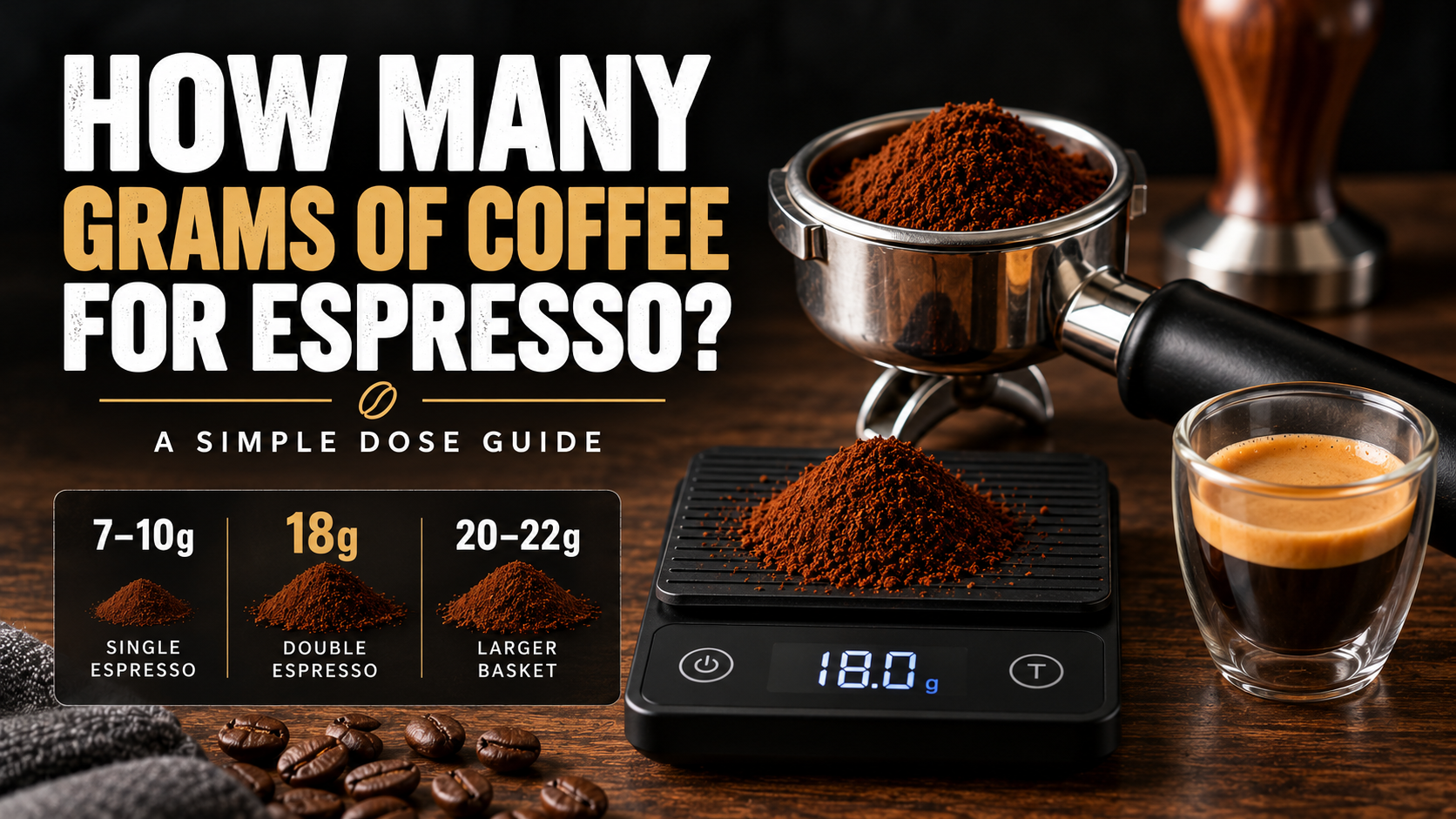
Use approximately 7–10 grams of ground coffee for a traditional single espresso or 16–20 grams for a double, depending on your basket’s recommended capacity. If you have an 18g basket, 18 grams is a useful starting dose.
These weights refer to the dry ground coffee in the basket, not the finished espresso in your cup. For example, an 18g coffee dose producing 36g of espresso gives you a 1:2 brew ratio.
Start with a dose that fits your basket, keep it consistent, and adjust your grind and target yield to improve the taste. You don’t need to use exactly 18g if your basket is designed for a different amount.
Affiliate Disclosure: Espresso Decoded is reader-supported. As an Amazon Associate, we earn from qualifying purchases. If you buy through links on this page, we may earn a commission at no additional cost to you.
Espresso Coffee Dose: Single and Double Shots
Use your basket manufacturer’s recommended dose range first. The table below gives common starting ranges when you’re comparing recipes.
| Basket type | Typical dry coffee dose | Example yield at a 1:2 ratio |
|---|---|---|
| Traditional single | 7–10g | 14–20g |
| Double | 16–20g | 32–40g |
| Larger-capacity basket | 20–22g or more, depending on its rating | Twice your chosen dose |
The yield column shows the weight of espresso collected in the cup. It’s an example recipe, not a required serving size.
How Much Espresso Should 18 Grams of Coffee Make?
At a 1:2 brew ratio, 18g of ground coffee produces a target yield of 36g of espresso.
You can also try:
- 27g out: a shorter, more concentrated 1:1.5 recipe.
- 36g out: a common 1:2 starting recipe.
- 45g out: a longer, less concentrated 1:2.5 recipe.
These recipes will extract differently and can taste different even with the same beans. Start with one target yield, taste the result, and change one variable at a time.
If your basket is designed for 14g rather than 18g, use an appropriate dose for that basket. At a 1:2 ratio, 14g of coffee would give you a target yield of 28g.
Why 18 Grams Is a Good Starting Dose
You’ll often see espresso recipes built around 18 grams because many modern double baskets are designed for a dose somewhere around this range.
An 18-gram recipe is also easy to work with:
18g coffee → 36g espresso → approximately 25–30 seconds
That doesn’t mean every espresso should follow that exact recipe.
Different baskets, machines, grinders, coffees, and roast levels can all work better with slightly different doses.
But if you have no idea where to begin, 18 grams in and 36 grams out gives you a useful baseline.
Once you have that baseline, our guide to espresso shot time can help you understand whether your shot is flowing too quickly or too slowly.
Should You Use a Single or Double Espresso Dose?
The terms “single” and “double” can be surprisingly confusing.
Traditionally, a single espresso might use around 7 to 10 grams of coffee, while a double uses roughly twice that amount.
In modern home espresso, however, many people simply use a double basket for nearly every shot.
That’s why it’s often more useful to think in terms of grams of coffee rather than asking whether you’re making a single or double.
For example, saying:
“I use 18 grams of coffee and produce 36 grams of espresso”
tells you much more about the recipe than simply saying:
“I pulled a double.”
Measuring your coffee by weight makes the recipe repeatable.
Your Basket Size Matters More Than a Universal Dose
One of the biggest mistakes beginners make is choosing a dose from an espresso recipe online without considering the basket they’re using.
Your portafilter basket is designed to hold a certain amount of coffee.
If you have an 18-gram basket, starting around 18 grams makes sense.
If you have a smaller basket designed for 14 grams, trying to force 20 grams into it can create problems.
Likewise, putting only 12 grams into a basket designed for 18 or 20 grams may leave too much empty space and change how water moves through the puck.
So before copying someone else’s espresso recipe, check what size basket came with your machine.
The dose should fit the basket first.
What Happens If You Use Too Little Coffee?
Using too little coffee can reduce the resistance that the puck provides to the water.
That can cause your espresso to flow faster than expected.
You might notice a shot that tastes:
- Thin
- Weak
- Sour
- Watery
If your espresso is particularly thin, our guide to why espresso tastes watery covers the other common causes as well.
Don’t immediately add several grams of coffee to fix the problem, though.
If your dose already matches your basket, grind size is usually the better variable to adjust.
A finer grind generally creates more resistance and slows the shot.
What Happens If You Use Too Much Coffee?
More coffee isn’t automatically better.
Overfilling your basket can leave too little space between the coffee puck and the espresso machine’s shower screen.
That may make it difficult for water to flow evenly through the coffee and can contribute to inconsistent extractions.
An excessively high dose can also slow the shot considerably.
If your basket is designed for approximately 18 grams, there’s usually little reason to cram 22 or 23 grams into it simply because you want stronger espresso.
Instead, use the basket as intended and adjust your recipe from there.
Espresso Dose vs. Espresso Yield
Your dose and your yield are not the same thing.
Dose is the amount of dry coffee you put into the portafilter.
Yield is the amount of liquid espresso that ends up in your cup.
For example:
Dose: 18 grams
Yield: 36 grams
That creates a 1:2 brew ratio.
Another recipe might be:
Dose: 18 grams
Yield: 27 grams
That’s a shorter, more concentrated shot.
Or:
Dose: 18 grams
Yield: 45 grams
That’s a longer shot with more liquid in the cup.
This is why knowing how many grams of coffee you’re using is only the beginning. You also need to know how much espresso you’re producing.
Our espresso ratio guide explains this relationship in much more detail.
Should You Measure Espresso Coffee in Grams or Tablespoons?
Use grams.
Tablespoons are not precise enough for dialing in espresso.
Different coffees have different densities, bean sizes, and roast levels. One tablespoon of one coffee may not contain exactly the same amount of coffee as one tablespoon of another.
A scale removes that uncertainty.
Instead of guessing whether you added enough grounds, you can know:
18.0 grams in.
Then place your cup on the scale during extraction and stop the shot when you reach your target yield:
36.0 grams out.
A small coffee scale with a built-in timer makes this especially convenient because you can monitor dose, yield, and shot time using the same tool.
Does Roast Level Change How Many Grams You Should Use?
It can.
Dark-roasted coffee is generally less dense and takes up more physical space than a lighter roast at the same weight.
That means 18 grams of a dark roast may sit higher in the basket than 18 grams of a dense light roast.
You don’t necessarily need to change your dose every time you change coffee, but it’s worth paying attention to how the puck fits in the basket.
If a new coffee suddenly seems overcrowded, reducing the dose slightly may make sense.
If the basket seems significantly underfilled, a small increase may help.
Make small adjustments rather than changing several grams at once.
Should You Change Dose or Grind Size First?
If your dose already matches your basket, keep the dose consistent and adjust grind size first.
For example, suppose your recipe is:
18g in → 36g out → 18 seconds
The shot tastes sour and runs much faster than expected.
Instead of increasing the dose to 20 grams, keep using 18 grams and grind slightly finer.
Then pull another shot.
Changing one variable at a time makes it much easier to understand what actually improved—or worsened—the espresso.
Our guide to espresso grind size explains how finer and coarser adjustments affect extraction.
A Simple Espresso Recipe for Beginners
If you just bought an espresso machine and want somewhere to start, use this:
Dose: 18 grams
Yield: 36 grams
Ratio: 1:2
Shot time: approximately 25–30 seconds
Then taste the espresso.
If it runs very quickly and tastes sour or thin, grind finer.
If it runs very slowly and tastes excessively bitter or dry, grind coarser.
If the shot falls outside the traditional time range but tastes excellent, you don’t need to change it simply to hit a specific number.
The goal is not to make your espresso machine produce perfect numbers.
The goal is to use those numbers to consistently make espresso that tastes good.
Frequently Asked Questions
How many grams of coffee are in one espresso shot?
A traditional single espresso often uses around 7 to 10 grams of coffee, but many modern home espresso recipes use a double basket with approximately 16 to 20 grams.
Is 18 grams of coffee a single or double espresso?
An 18-gram dose would generally be considered a double espresso dose. However, basket size and brew ratio are more useful measurements than the single-versus-double label.
How much espresso should 18 grams of coffee make?
A common starting point is 36 grams of liquid espresso from 18 grams of ground coffee. That is a 1:2 brew ratio.
You can use a shorter or longer ratio depending on the coffee and your taste preferences.
Is 20 grams too much for espresso?
Not if your basket is designed for it.
Many larger espresso baskets are designed for approximately 20 grams of coffee. But putting 20 grams into a basket designed for 14 or 16 grams can overcrowd it.
Can I use 15 grams of coffee for espresso?
Yes, as long as the dose is appropriate for your basket.
There is no rule requiring every espresso recipe to use 18 grams. Consistency and matching the dose to the basket matter more than following one universal number.
Do I need a scale for espresso?
You can make espresso without a scale, but a scale makes dialing in significantly easier.
Measuring both your coffee dose and espresso yield lets you repeat successful shots and diagnose problems much more accurately than estimating by volume.
Final Thoughts
So, how many grams of coffee for espresso should you use?
For many home espresso setups, 18 grams is the best place to start.
Pair that with roughly 36 grams of espresso for a simple 1:2 recipe, then adjust based on your basket, coffee, equipment, and—most importantly—taste.
Don’t obsess over whether another person’s recipe uses 17, 18, or 20 grams.
Use a dose that fits your basket, weigh it consistently, keep your target yield consistent, and adjust one variable at a time.
Once you understand dose, yield, grind size, and shot time together, dialing in espresso becomes much easier.